Studio note
Painting the Code of Life
How molecular plant cell biology became the visual language of my surreal landscapes.
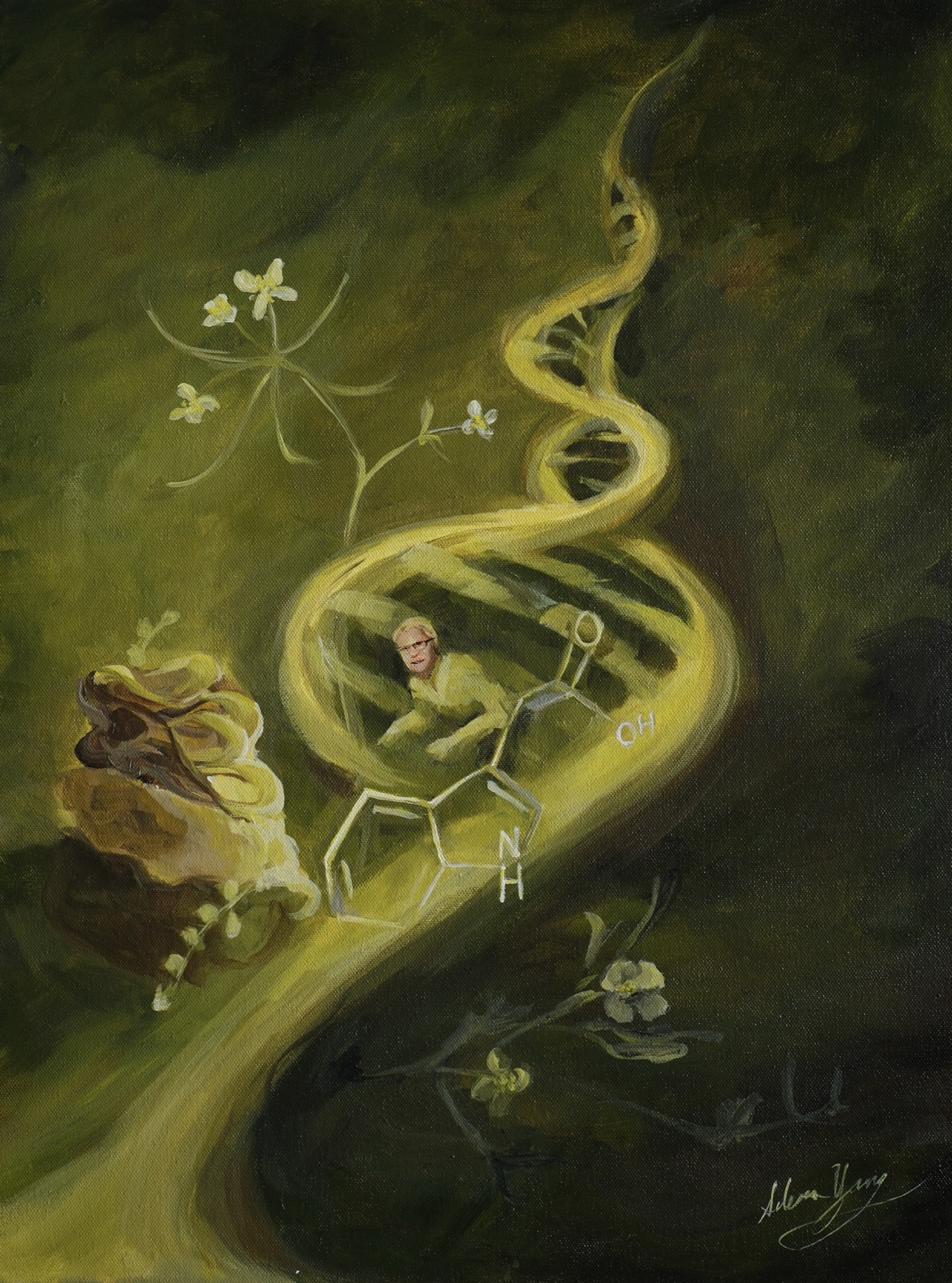
I use plant cell biology as a visual grammar rather than a subject to illustrate. Membranes become horizons, organelles become inhabitants, and growth signals become movement across a painted world.
A scientific image is already a landscape
When I look at an image of a plant cell, I do not see a diagram waiting to be copied. I see territories. A cell wall can read as architecture; a membrane can behave like a shoreline; an organelle can feel as present and strange as a building encountered in a dream. The scientific image gives me a system of boundaries, passages, densities, and exchanges. Painting lets me ask what it would feel like to enter that system.
That shift in scale is the beginning of my Organic Utopia paintings. The work grows from molecular plant cell biology, but it does not stay at the scale of a microscope. Cellular structures expand into terrain. Forms that might be measured in micrometers become vast enough to wander through. The biology remains embedded in the image, while the painting opens into a place with its own weather and emotional logic.
Structure becomes atmosphere
Plant cells are held by structures that are both protective and responsive. Cell walls provide strength without making life static. Membranes create separation while still allowing exchange. Those tensions matter to me as a painter: enclosure and openness, order and mutation, stability and growth.
In Auxin Growth Factor, the title points to a plant hormone associated with growth and development. I was interested less in illustrating a pathway than in translating the feeling of directional growth. The forms seem to respond to an invisible instruction. Space stretches, bends, and organizes itself around movement.
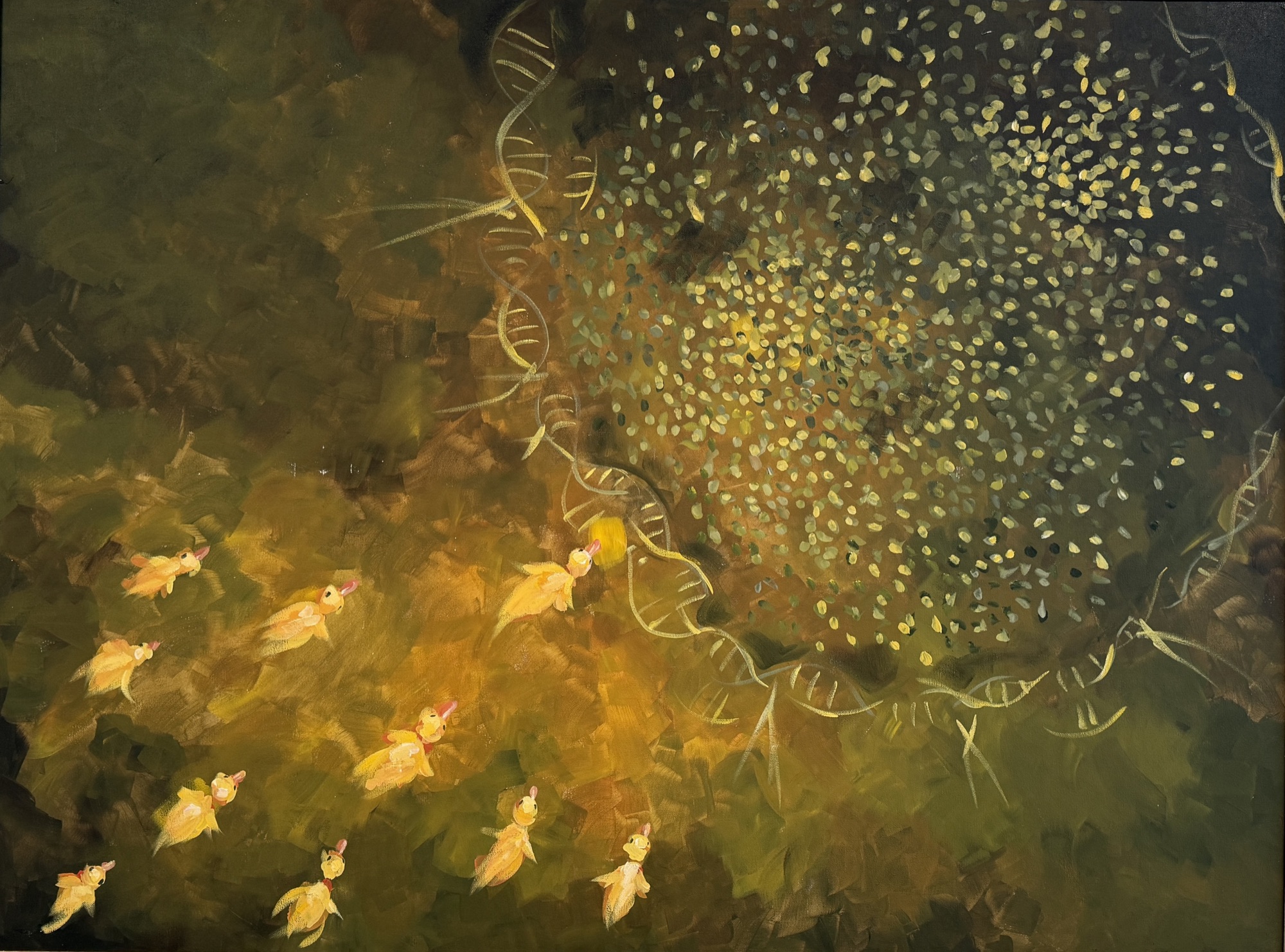
CRISPR Duckweed begins with another charged meeting of biology and human agency. Duckweed is small and ordinary; CRISPR is a tool that has changed how we imagine editing living systems. In the painting, that combination becomes a world rather than a claim. The landscape holds possibility, unease, play, and control at the same time.
The work stops short of illustration
Accuracy matters in the studio, but so does departure. If a painting merely reproduced a scientific image, it would close too quickly. I want the biological reference to give the painting internal coherence while leaving room for recognition that cannot be named immediately.
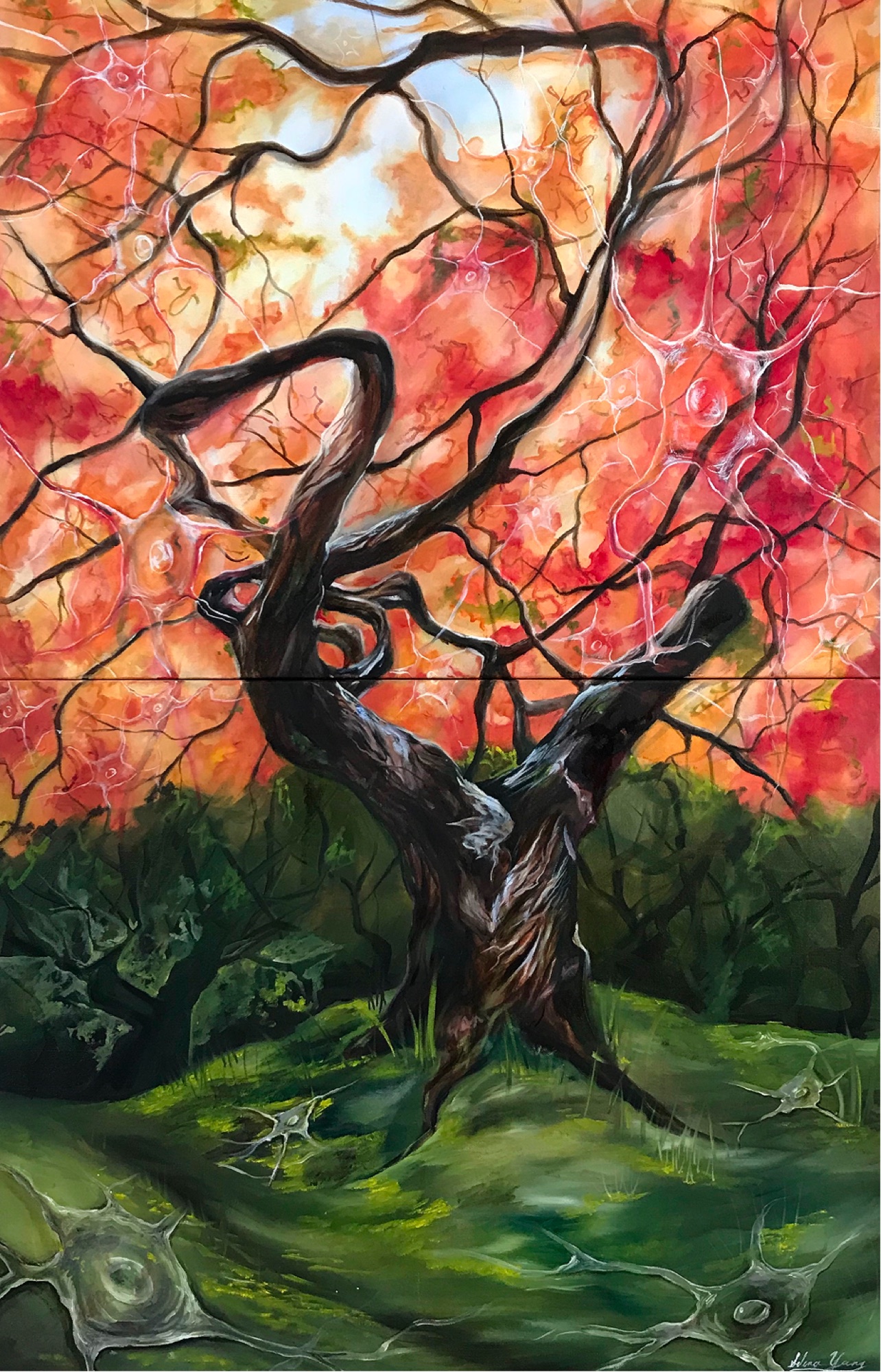
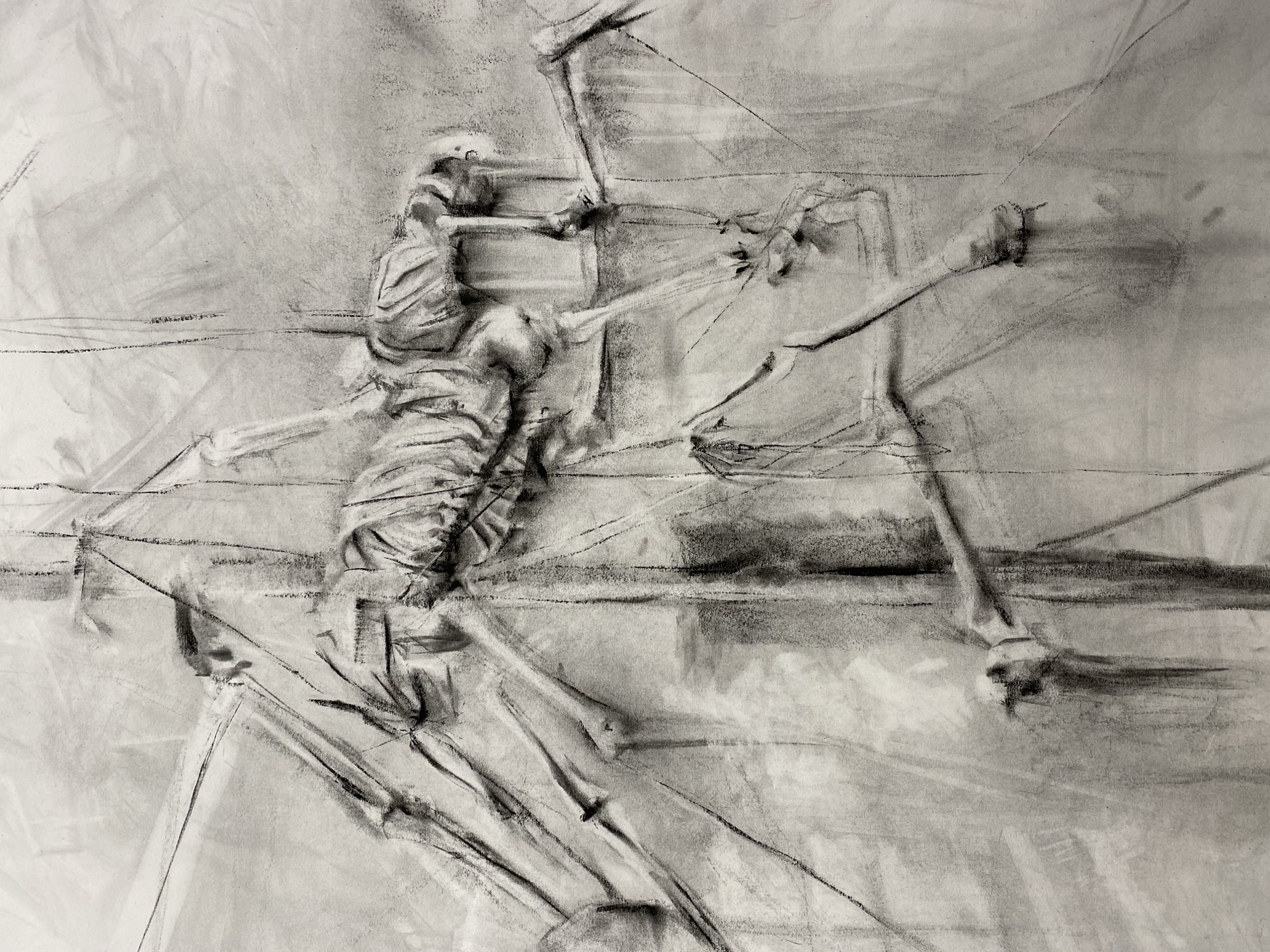
That is why works such as Organic Matter and Neuron Tree move between familiar and unfamiliar states. A viewer may recognize branching, division, growth, or decay without deciding whether the image is microscopic, planetary, or bodily. The ambiguity is not a puzzle with one answer. It is the space in which the painting becomes active.
A language shared across art and science
My father is a plant cell molecular biologist, and our collaboration is part of how this language continues to develop. Science gives names to structures and processes that would otherwise remain invisible. Painting lets those structures carry scale, atmosphere, memory, and intuition. Neither discipline needs to become the other for the exchange to matter.
I think of the paintings as propositions: perhaps the code of life is not remote from us, and perhaps scientific knowledge can deepen wonder rather than replace it. An Organic Utopia is not a perfect world. It is a world in which living systems, scientific discovery, and human imagination are understood as inseparable.
Scientific references
These sources provide biological context for ideas discussed in the essay.
At What Scale Are We Looking?
Why a cell can become a landscape, and a landscape can behave like a cell.
Painting With a Plant Cell Molecular Biologist
Notes on a father-daughter collaboration across art, science, and ways of seeing.